Description
A simple continuous stitch can be a useful technique for skin closure when speed is important, e.g. closing a scalp laceration on a screaming child.
The simple running, or continuous suture, is begun in the same way as a simple interrupted suture. Again, it is important to grasp the skin and evert it slightly using a fine toothed forcep, and the needle holder is rotated into a pronated position in preparation for piercing the skin.
The needle is then driven through the full thickness of skin by supinating the wrist to rotate the needle and pass it through the skin.
The wrist is then pronated again in order to regrasp the needle, and the wrist is then supinated to complete passage of the needle through the skin.
This process is repeated for the skin edge closest to the surgeon.
Once the second “bite” has been taken, the suture is tied off using square knots, just as if it were a simple interrupted stitch, except that only the short strand is cut, leaving about a 3-4 mm tail
Here, the first stitch has been tied off, and the surgeon prepares to place a second stitch about 3 mm away from the first.
Video
Courses
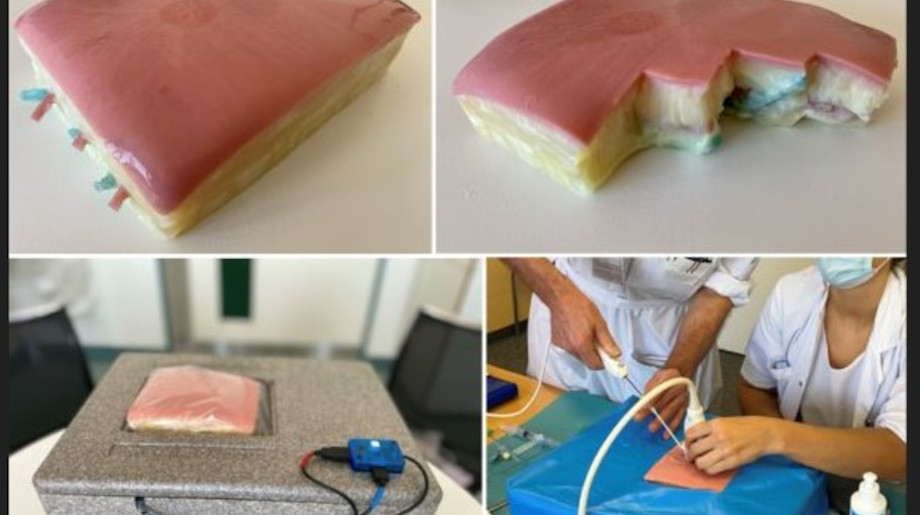
Ultrasound – guided pAVF workshop
This workshop offers simulation training of ultrasound- guided pAVF with a theoretical background. The course is accredited by the Swiss

Lucerne Fundamentals in Vascular Surgery 2024
The Lucerne/Sarnen Fundamentals in Vascular Surgery Techniques workshop provides an excellent hands-on experience on uniquely realistic pulsatile models to perform
Training Models
The End-to-End Running Suture procedure can be safely and effectively trained with the following models